

Join us at Calvary Episcopal Church for Holy Week, as we journey with Jesus through his last week before his death and glorious resurrection. Here, you’ll find event listings and more information about the significance of each observance. Please see the bottom of the page for a calendar of upcoming events during Lent and Holy Week 2026. All are welcome!
All descriptions on this page are adapted from An Episcopal Dictionary of the Church.
Wednesday, February 18 – Ash Wednesday
12:00 pm: Holy Eucharist and Imposition of Ashes
7:00 pm: Holy Eucharist and Imposition of Ashes
The first of the forty days of Lent, named for the custom of placing blessed ashes on the foreheads of worshipers at Ash Wednesday services. The ashes are a sign of penitence and a reminder of mortality, and may be imposed with the sign of the cross. Ash Wednesday is observed as a fast in the church year of The Episcopal Church. The Ash Wednesday service is one of the Proper Liturgies for Special Days in the BCP (p. 264).
Weekly Offerings during Lent
Sundays between February 22 and Palm Sunday
Lenten Book Study: All are invited to be a part of a book study this Lent during the time between the Sunday services, beginning on February 22 and ending on Palm Sunday. We will be using the book, For Such a Time as This: An Emergency Devotional, by Hanna Reichel. Professor Reichel is the Charles Hodge Professor of Systematic Theology at Princeton Theological Seminary and an elder in the PCUSA. The book is described as “a guide for ordinary Christians seeking to live faithfully in extraordinary times.” The cost for the paperback is $19.00 on Amazon. If you would like to participate and would like some assistance in purchasing the book, please let Rev. Beth know.
Every Monday at 5:15 pm
Service of Holy Eucharist with Healing Prayers and Anointing: Join us in the church each week for our healing service, featuring prayers, Holy Eucharist, and anointing for healing. All are welcome!
Every Wednesday at 12:05 pm
Holy Eucharist and Silent Meditation: Join us Wednesdays in Lent for a service of Holy Eucharist, Rite II, with a period of silent meditation. The service begins at 12:05 pm.
Sunday, March 29 – Palm Sunday
8:30 am: Holy Eucharist with the Rite I liturgy and the Liturgy of the Palms
The Sunday before Easter at which Jesus’ triumphal entry into Jerusalem and Jesus’ Passion on the cross are recalled. It is also known as the Sunday of the Passion. Palm Sunday is the first day of Holy Week. Red is the liturgical color for the day. The observance of Palm Sunday in Jerusalem was witnessed by the pilgrim Egeria in about 381–384. During this observance there was a procession of people down the Mount of Olives into Jerusalem. The people waved branches of palms or olive trees as they walked. They sang psalms, including Ps 118, and shouted the antiphon, “Blessed is he who comes in the name of the Lord!”
The liturgy of the palms is the entrance rite for the service. The congregation may gather at a place apart from the church and process to the church after the blessing of the branches of palm or other trees (BCP, p. 270). The liturgy of the palms includes a reading of one of the gospel accounts of Jesus’ entrance into Jerusalem. The branches may be distributed to the people before the service or after the prayer of blessing. All the people hold branches in their hands during the procession. Appropriate hymns, psalms, or anthems are sung. The procession may halt for a station at an appropriate place such as the church door. When the service includes the eucharist, the liturgy of the palms is followed by the salutation and the collect of the day. The service changes focus abruptly from the triumphal entry into Jerusalem to the solemnity of the Passion. In the 1979 BCP, the Passion gospel is drawn from one of the three synoptic accounts of the Passion, one of which is appointed for each of the three years in the eucharistic lectionary. The Passion gospel is announced simply, “The Passion of our Lord Jesus Christ according to _________.” The Passion gospel may be read or chanted by lay persons. Specific roles may be assigned to different persons, with the congregation taking the part of the crowd (BCP, p. 273). It is customary to observe a brief time of silence when the moment of Jesus’ death is described by the narrator.
Monday, March 30
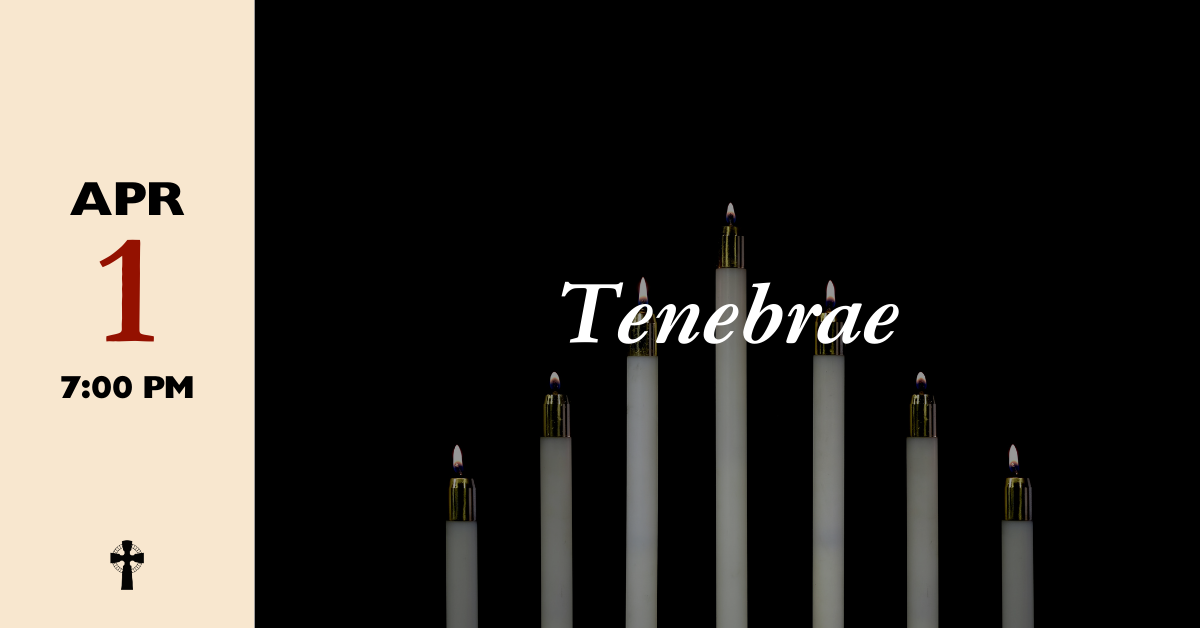
Wednesday, April 1
12:05 pm: Holy Eucharist
7:00 pm: Tenebrae with the Motet Choir
This form of the monastic office (matins and lauds) is commonly adapted for congregational use during Holy Week. The office is structured around psalms, readings, and responsories. A distinguishing characteristic of this service is the series of readings from Lamentations which appear early in the office. The distinctive ceremonial of Tenebrae includes use of fifteen lighted candles, often set on a special, triangular stand. One candle is extinguished as each of the fourteen appointed psalms is completed. The fifteenth candle, symbolic of Christ, is left lighted at the end of the final psalm. But it is carried away to be hidden, which signifies the apparent victory of the forces of evil. A sudden loud noise is made at the end of the service, symbolizing the earthquake at Christ’s death. The lighted candle is then restored to its place, suggesting Christ’s eventual triumph.
Thursday, April 2 – Maundy Thursday
7:00 pm: Holy Eucharist and Stripping of the Altar
The Thursday in Holy Week. It is part of the Triduum, or three holy days before Easter. It comes from the Latin mandatum novum, “new commandment,” from Jn 13:34. The ceremony of washing feet was also referred to as “the Maundy.” Maundy Thursday celebrations also commemorate the institution of the eucharist by Jesus “on the night he was betrayed.” Egeria, a fourth-century pilgrim to Jerusalem, describes elaborate celebrations and observances in that city on Maundy Thursday. Special celebration of the institution of the eucharist on Maundy Thursday is attested by the Council of Hippo in 381. There is provision for the consecration of the bread and wine for administering Holy Communion from the reserved sacrament on Good Friday. Following this, the altar is stripped and all decorative furnishings are removed from the church.
Friday, April 3 – Good Friday
12:00 pm: Good Friday Liturgy
7:00 pm: Good Friday Liturgy
The Friday before Easter Day, on which the church commemorates the crucifixion of Jesus. It is a day of fasting and special acts of discipline and self-denial. In the early church candidates for baptism, joined by others, fasted for a day or two before the Paschal feast. In the west the first of those days eventually acquired the character of historical reenactment of the passion and death of Christ. The liturgy of the day includes John’s account of the Passion gospel, a solemn form of intercession known as the solemn collects (dating from ancient Rome), and optional devotions before the cross (commonly known as the veneration of the cross). The eucharist is not celebrated in the Episcopal Church on Good Friday, but Holy Communion may be administered from the reserved sacrament at the Good Friday service.
Saturday, April 4 – Holy Saturday
7:00 pm: Easter Vigil and first Eucharist of Easter
Agape Potluck Meal following the service
The liturgy is intended as the first (and arguably, the primary) celebration of Easter in the BCP (pp. 284-95). It is also known as the Great Vigil. The service begins in darkness, sometime between sunset on Holy Saturday and sunrise on Easter, and consists of four parts: The Service of Light (kindling of new fire, lighting the Paschal candle, the Exsultet); The Service of Lessons (readings from the Hebrew Scriptures interspersed with psalms, canticles, and prayers); Christian Initiation (Holy Baptism) or the Renewal of Baptismal Vows; and the Eucharist. Through this liturgy, the BCP recovers an ancient practice of keeping the Easter feast. Believers would gather in the hours of darkness ending at dawn on Easter to hear scripture and offer prayer. This night-long service of prayerful watching anticipated the baptisms that would come at first light and the Easter Eucharist. Easter was the primary baptismal occasion for the early church to the practical exclusion of all others. This practice linked the meanings of Christ’s dying and rising to the understanding of baptism.
Sunday, April 5 – Easter Day
8:30 am: Holy Eucharist, Rite I
9:15 am: Children’s Easter Egg Hunt
10:30 am: Festal Holy Eucharist Rite II with Choir and Musical Ensemble
The feast of Christ’s resurrection. Easter Day is the annual feast of the resurrection, the pascha or Christian Passover, and the eighth day of cosmic creation. Faith in Jesus’ resurrection on the Sunday or third day following his crucifixion is at the heart of Christian belief. Easter sets the experience of springtime next to the ancient stories of deliverance and the proclamation of the risen Christ. In the west, Easter occurs on the first Sunday after the full moon on or after the vernal equinox. Easter always falls between Mar. 22 and Apr. 25 inclusive. Following Jewish custom, the feast begins at sunset on Easter Eve with the Great Vigil of Easter.